Compare the Uluru base walk tour options — self-guided vs guided. Costs, fitness demands, cultural insight and crowd levels, explained plainly.
Options at a Glance
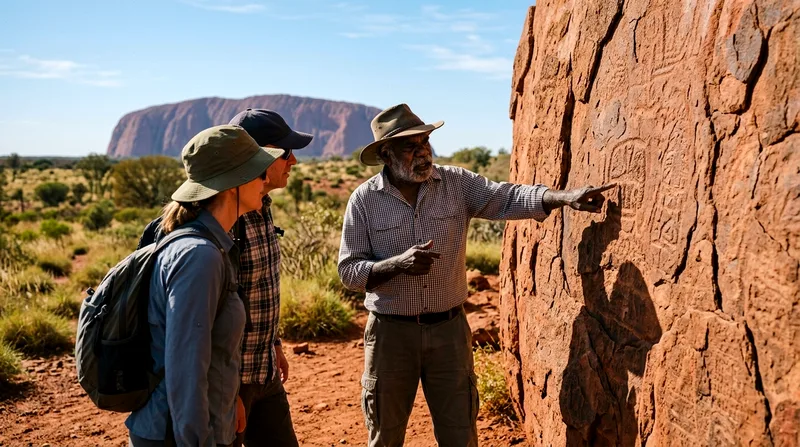
Walking the 10.6-kilometre loop around Uluru is the single best way to understand why this rock matters — far better than any lookout photo stop on a coach tour. The question isn't whether to do the base walk, it's how. You can lace up and go it alone, following the sealed path at your own pace with interpretive signs along the way, or you can join a guided tour, usually led by an Aboriginal guide or a trained operator working in partnership with the local Anangu community, who'll walk a shorter section with you and explain what the signs can't.
Both get you around (or partway around) the same rock. The difference is what you walk away knowing, how much it costs, and how your morning is structured. Uluru-Kata Tjuta National Park entry costs AUD 38 per adult (valid three days), and that fee applies whether you walk solo or with a group — it's the entry ticket, not the tour, that's mandatory.
Self-guided walk overview
The self-guided Uluru base walk follows a flat, sealed and sandy path hugging the rock's perimeter, split into named sections — Mala Walk, Kuniya Walk, Lungkata Walk and others — each with interpretive signage explaining geology or Tjukurpa (traditional law and stories) at a basic level. You can start anywhere, walk clockwise or counter-clockwise, and bail out early via several car park access points if the heat or your energy level gets the better of you. There's no booking, no fixed start time, and no cost beyond the park entry fee. It suits travelers who want flexibility above all else, but you'll get only the surface-level cultural information that's considered appropriate for public signage — plenty of the real stories stay with the guides.
Guided tour overview
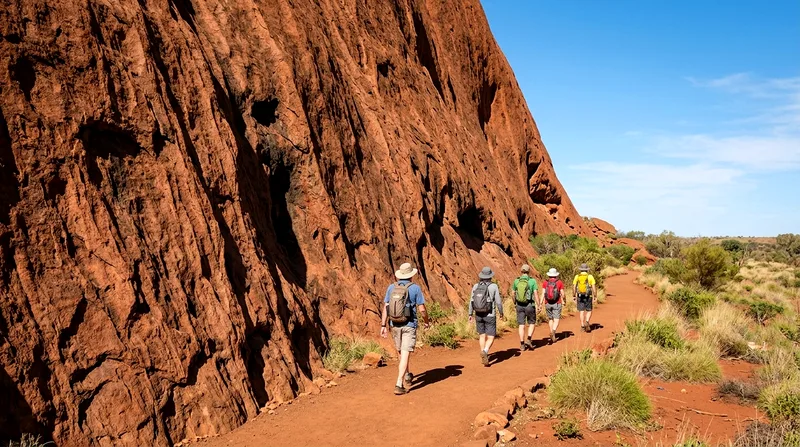
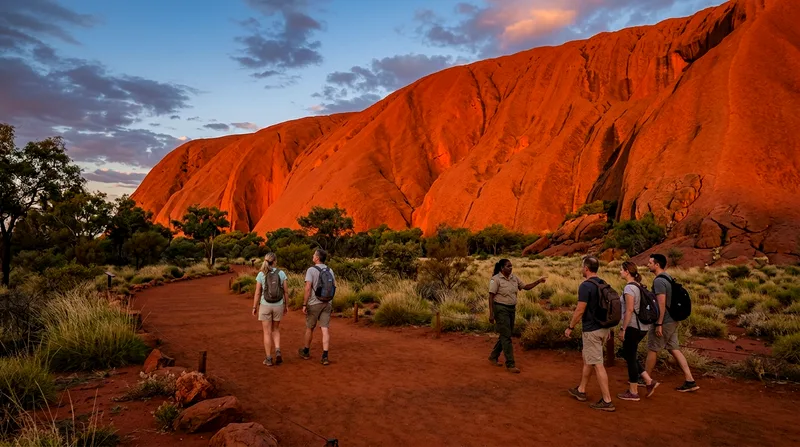
Guided base walk tours typically cover a shorter stretch — often the Mala and Kuniya sections, roughly 2 to 4 kilometres — rather than the full loop, and run for 1.5 to 2 hours with a fixed morning departure time, usually timed around sunrise to beat the heat. Prices generally run from AUD 70 to AUD 140 per adult depending on group size, inclusions, and whether it's a standalone walk or bundled with a sunrise viewing and breakfast. The park entry fee is usually separate unless stated otherwise. What you're really paying for is the guide — often an Anangu guide or a non-Indigenous interpreter trained through the Anangu-run cultural program — translating rock art, waterholes, and stories that aren't written on any sign.
Head-to-Head Comparison: Uluru Base Walk Tour Options
Here's where the decision actually gets made. Both options use the same trail network inside Uluru-Kata Tjuta National Park, but the experience diverges fast once you look at time, cost, and what you actually learn.
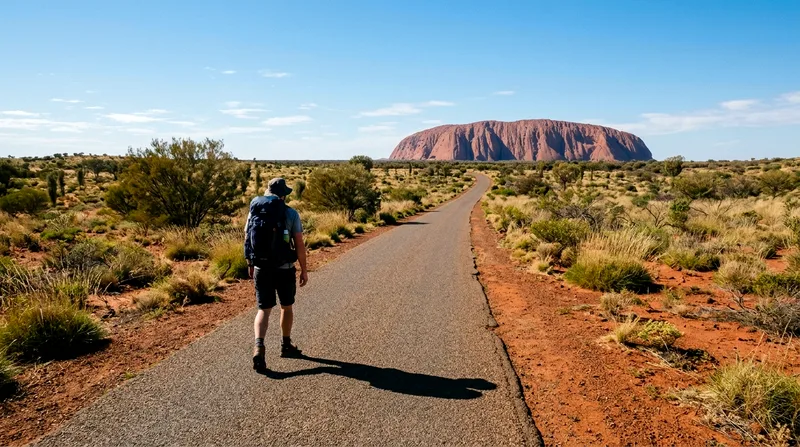
Self-guided walking covers more ground for less money, while guided tours trade distance for cultural depth and a cooler start time.
Uluru base walk tour comparison: self-guided vs guided options
| Option | Distance Covered | Duration | Approx. Cost (AUD) | Cultural Depth | Best Time of Day |
|---|---|---|---|---|---|
| Self-guided full loop | 10.6 km | 3-3.5 hrs | 38 (park entry only) | Basic (signage) | Dawn, before 8am in summer |
| Guided Mala/Kuniya walk | 2-4 km | 1.5-2 hrs | 70-140 plus park entry | Deep (Aboriginal guide) | Sunrise departure |
| Self-guided partial (one section) | 1-4 km | 30-90 min | 38 (park entry only) | Basic (signage) | Any time, avoid midday heat |
| Guided tour + breakfast add-on | 2-4 km | 2.5-3 hrs | 120-180 plus park entry | Deep (Aboriginal guide) | Sunrise start |
Figures are typical ranges; always check current prices and start times when booking, since they shift seasonally.
Time and distance
The full base walk is 10.6 km and takes most people 3 to 3.5 hours at an easy pace, including stops for photos and water breaks. Walking it solo, you set that pace — some senior travelers stretch it to 4.5 hours with frequent rests, which is fine since there's no group to keep up with. Guided tours rarely attempt the full loop; most cover 2 to 4 km in 1.5 to 2 hours, focused on the most culturally significant sections near Mala carpark and Kuniya Piti. If you want to say you've circled the whole rock, you'll need to do that part yourself, either before or after the guided segment.
Cost and value
Self-guided costs you nothing beyond the AUD 38 park pass — genuinely the best free activity in the Red Centre. Guided tours add AUD 70-140 per person on top of that. Is it worth it? For a family of four, that's potentially an extra AUD 280-560, which starts rivaling the cost of a Kings Canyon rim walk day trip or a half-day Kata Tjuta tour. I'd rather travelers spend on one well-chosen guided experience — the base walk or a Kata Tjuta cultural walk, not both — than stretch a tight budget across everything.
Physical effort required
Both versions are flat and easy by hiking standards — no scrambling, no elevation gain to speak of, unlike the steeper, rockier terrain at Kings Canyon's Rim Walk or parts of the MacDonnell Ranges. The challenge at Uluru is heat and distance, not gradient. Summer temperatures regularly exceed 40°C by mid-morning, and the park closes the walk if forecast heat crosses certain thresholds. Guided tours sidestep this by starting at sunrise; self-guided walkers need to start by 7am in warmer months or risk finishing in brutal heat with no shade for most of the route.
Views and photography
Photographers generally do better self-guided, simply because you can stop as long as you like at each angle without holding up a group. The light changes constantly as you circle the rock — different textures and colors appear on the Mutitjulu Waterhole side versus the open sections facing the car parks. Guided tours move on a schedule, so if you're chasing a specific shot at Kantju Gorge, you might feel rushed. That said, guides often know exactly when morning light hits certain rock art panels best, which a solo walker would miss entirely.
Crowds and solitude
Crowd levels shift by season and time of day more than by walk type. Dawn starts — whether solo or guided — consistently beat the heat and the tour-bus crush that arrives from 9am onward. Winter (June-August) brings the biggest crowds overall since temperatures are mild, while summer (December-February) is quieter but punishingly hot. Guided groups are typically capped at 10-20 people, so you're not alone, but you're also not fighting through the dozens of independent walkers who show up later in the morning near the main car park access points.
Cultural knowledge gained
This is the real differentiator. Self-guided signage explains basic Tjukurpa concepts and geological facts in a few sentences per sign — useful, but thin. A guided tour, particularly one led by an Aboriginal guide, explains the Mala and Kuniya stories in proper context, points out rock art you'd otherwise walk straight past, and explains why certain sections of the rock are off-limits to photography for cultural reasons. If understanding Anangu culture is part of why you're visiting the Red Centre at all — rather than just ticking off a landmark — the guided option earns its price here.
Who Should Choose Which
Neither option is objectively better — it depends on what you're optimizing for: budget, time, fitness, or depth of understanding. Below is how I'd split the decision for different traveler types.
Best for self-guided walkers
Choose self-guided if you're on a tight Red Centre itinerary that also includes Kata Tjuta, Kings Canyon, and maybe a side trip to Coober Pedy or Alice Springs — budget discipline matters when you're covering that much ground. Solo travelers and couples comfortable navigating independently will find the signage adequate, and families with children under 10 often do better self-guided since you can turn back at any of the several car park exit points without disrupting a group schedule. Fit senior travelers who want to go at their own pace, stopping often, also tend to prefer this option — there's no pressure to keep up.
Best for guided tour takers
Choose guided if this is a once-in-a-lifetime trip to the Northern Territory and you want the Aboriginal perspective, not just the view. First-time visitors to Ayers Rock, culturally curious travelers, and anyone pairing Uluru with a broader Aboriginal-led experience elsewhere in the Red Centre or at Kakadu National Park up in Darwin's orbit will get more out of it. European and other long-haul travelers who've flown a long way for this one stop should strongly consider it — you're unlikely to be back, and the context a guide provides is hard to replicate from a signboard, however well written.
The Verdict on the Uluru Base Walk Tour
If you're budget-conscious, pressed for time, or simply want the flexibility to turn back whenever you feel like it, the self-guided Uluru base walk delivers real value for AUD 38 — the price of park entry you're paying anyway. It's not a lesser experience, just a quieter and less informed one.
If cultural understanding is the point of visiting Uluru at all — and for most travelers who've come this far, it probably should be — book a guided walk with an Aboriginal guide. Pair it with a Kata Tjuta half-day tour or a Kings Canyon rim walk later in your Red Centre itinerary, and you'll leave with a far richer picture of the region than the rock alone provides. My honest take: do a short guided walk at sunrise for the stories, then return later (same day or the next) to self-guide the rest of the loop at your own pace. You get both the context and the completion, for a combined cost that's still reasonable against the whole trip. Compare current base walk tours and prices before you book, since inclusions and departure times shift with the season.
Frequently asked questions
How long does the Uluru base walk take?
The full 10.6 km loop takes 3 to 3.5 hours walking solo at a relaxed pace with photo stops. Guided tours typically cover only 2-4 km of the route in 1.5 to 2 hours, focused on the Mala and Kuniya sections near the main car parks rather than the entire perimeter.
What is the cost difference between self-guided and guided options?
Self-guided costs just the AUD 38 park entry fee (valid three days). Guided tours add roughly AUD 70-140 per adult on top of that, sometimes more if breakfast or sunrise viewing is bundled in. Check current prices when booking, since inclusions vary by operator.
Do I need a guide to walk around Uluru?
No — the path is sealed, flat, well-signed, and open to independent walkers daily (weather permitting). A guide isn't required for safety or navigation; it's purely about adding cultural context and Aboriginal storytelling you won't get from the interpretive signage alone.
What will I learn on a guided Uluru base walk?
Expect explanations of Tjukurpa stories tied to specific rock features, context on why certain sites are photography-restricted, insight into traditional use of waterholes like Mutitjulu, and rock art interpretation — details that go well beyond what's printed on trailside signs.
Is the base walk suitable for all fitness levels?
The terrain is flat and easy, suitable for most fitness levels including many seniors and children. The real challenge is heat and distance, not difficulty — start by 7am in warmer months, carry at least 1 liter of water per hour, and use the car park exit points to shorten the walk if needed.